
A slow drain is easy to ignore. A backed-up sewer line is not. Murray homeowners deal with a range of drain and sewer problems that tend to get dismissed until they become genuinely disruptive, and by then the repair is almost always more involved than it would have been if the warning signs had been caught earlier. Huskies Leak Detection serves Murray and surrounding Salt Lake County communities with professional drain cleaning, sewer camera inspection, sewer repair, and sewer replacement, and this guide covers the most common problems we see in Murray, what causes them, and what the repair process looks like.
Why Murray Sewer Lines Fail
Murray sits in a central Salt Lake Valley location that was developed across several different eras of residential construction. The mix of housing stock matters for sewer lines because the material your sewer pipe is made of determines how it ages, what causes it to fail, and how it gets repaired.
Clay tile pipe is the most common original sewer material in Murray's older neighborhoods, particularly homes built before 1970. Clay tile was the standard for decades because it was durable and widely available. The problem is that clay tile is installed in sections with bell-and-spigot joints that are packed with mortar or oakum rather than a continuous watertight seal. Over 50 or 60 years, those joints shift, dry out, and open up gaps. Tree roots find the joints and grow inside. The pipe itself can crack or collapse under the weight of soil and foot traffic above.
Orangeburg pipe is less common but worth knowing about. Orangeburg is a bituminous fiber pipe that was used primarily from the 1940s through the 1970s as a lower-cost alternative to clay. It absorbs moisture over time and deforms, eventually collapsing inward. If a Murray home built in that era has never had a sewer inspection, Orangeburg is a real possibility and a genuine risk.
Cast iron pipe is common in mid-century homes and lasts significantly longer than clay or Orangeburg, but it corrodes from the inside over decades. The interior surface develops scale and buildup that reduces flow and eventually contributes to root intrusion and joint failures.
PVC pipe is the modern standard and is used in newer Murray construction and in most sewer repairs completed over the past 30 years. PVC does not corrode, has smooth interior walls that resist buildup, and uses solvent-welded joints that eliminate the gap vulnerability of older materials. A home with PVC sewer lines has far fewer problems to worry about than one with original clay or cast iron.
Beyond pipe material, Murray's clay-heavy soils create settlement and shifting that stresses sewer lines at joints and transitions over time. Salt Lake Valley's freeze-thaw cycles also contribute, as ground movement through repeated freezing and thawing opens up gaps in older jointed pipe systems.
Signs Your Murray Home Has a Drain or Sewer Problem
One Drain Is Slow
A single slow drain is almost always an isolated blockage. Kitchen sink drains accumulate grease and food debris. Bathroom sinks and tubs collect hair and soap scum. A slow drain that responds to cleaning the trap or using a drain snake is a localized issue, not a main line problem.
However, a drain that keeps coming back slow after cleaning is telling you something. Either the blockage is further down the line than a snake can reach, or there is a buildup issue in the branch line that needs a more thorough cleaning.
Multiple Fixtures Are Backing Up Simultaneously
When more than one fixture backs up at the same time, or when running one fixture causes another to gurgle or back up, the problem is in the main sewer line, not the individual fixture. Flushing the toilet and seeing the bathtub drain bubble is a classic sign. Running the kitchen sink and seeing the nearby floor drain back up is another. Multiple simultaneous backups always point to the main line and need professional attention the same day.
Sewage Odors Inside the Home
A sewage smell inside a Murray home without an active backup can come from a few sources: a dried-out P-trap that has lost its water seal, a cracked sewer line venting gas into the crawl space or basement, or a failing wax ring at the toilet base. Running water in rarely-used drains refreshes the P-trap seal. A smell that persists or is strongest near walls, floors, or in the crawl space warrants a sewer camera inspection to rule out a line breach.
Slow Drains Throughout the House
When every fixture in the house drains slowly rather than a single fixture, the restriction is in the main line rather than individual branch lines. This pattern often indicates grease accumulation, root intrusion, or a partial collapse somewhere in the main sewer line between the house and the connection to the municipal system.
Water or Sewage in the Yard
Wet patches in the yard without a recent rain, particularly near the sewer line run from the house to the street, indicate that sewage is escaping underground. This is a more advanced failure that has been building for some time before it surfaced visibly. It needs immediate professional assessment.
Foundation Cracks or Settled Areas Near the Sewer Run
A long-running underground sewer leak saturates the soil around the pipe. As that soil is repeatedly saturated and then dries, it settles unevenly. Over time, a significant sewer leak can cause the ground to settle noticeably along the pipe's path, creating depressions in the yard or stress on any structures above.
How Huskies Diagnoses Sewer Line Problems
Accurate diagnosis comes before any repair recommendation. A sewer problem that is diagnosed based on symptoms alone rather than direct inspection often results in either an incomplete repair or an unnecessary one.
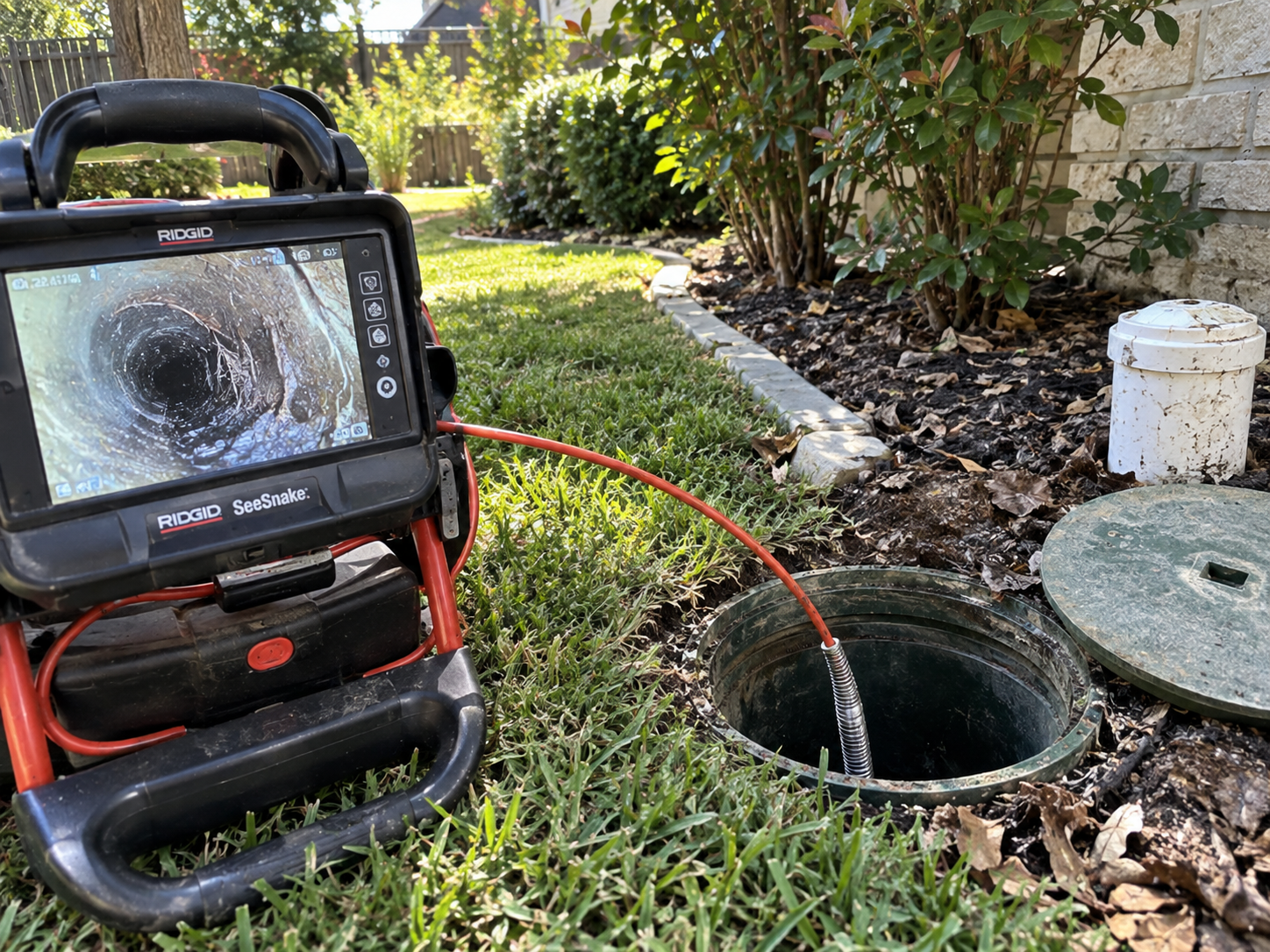
Sewer camera inspection is the definitive diagnostic tool for sewer line problems. A waterproof camera is run through the sewer line from a cleanout or the toilet base, transmitting real-time video of the interior of the pipe. This shows exactly what is happening inside the line: root intrusion at specific joints, a section of collapsed pipe, a belly or low spot where debris accumulates, a grease blockage, or a back-pitched section that drains improperly. The camera footage also shows what the pipe is made of and its overall condition beyond just the problem area.
The camera inspection determines the repair approach. A root intrusion in an otherwise intact clay pipe might be addressed with hydro jetting followed by a targeted repair at the affected joint. A collapsed section needs replacement of that section. A pipe that shows extensive root intrusion throughout its full length and multiple joint offsets is a candidate for full replacement rather than repeated spot repairs.
Pressure testing supplements camera inspection when a gas-based or underground leak is suspected but not visible on camera.
Drain Cleaning Methods: When to Use Each One
Not all drain cleaning is the same, and using the wrong method for the situation either does not fix the problem or makes it worse.
Drain snaking uses a rotating auger to break up or retrieve a blockage. It works well for localized clogs in fixture branch lines and is the right first tool for a single slow or stopped drain. A snake does not clean the pipe walls. It punches through or pulls out the obstruction, which resolves the immediate blockage but leaves behind buildup that caused it.
Hydro jetting uses a high-pressure water stream directed through a specialized nozzle to scour the interior walls of the pipe clean. It removes grease buildup, mineral scale, and debris that snaking cannot touch, and it can cut through root intrusion in the early stages before it becomes structural damage. Hydro jetting is the right tool for a drain that keeps coming back slow, a main line with grease accumulation, or a sewer line with early-stage root intrusion that the camera inspection confirms is otherwise intact. It is not appropriate for pipes that are already fragile or partially collapsed, where the pressure could cause further damage.
Root cutting is a specialized attachment used in addition to hydro jetting when root intrusion is significant. The cutter removes roots from inside the pipe, which restores flow. This is a maintenance repair rather than a permanent fix. Roots that have found a joint will continue to grow back unless the underlying joint is repaired or the pipe is relined.
Sewer Repair Options in Murray
When camera inspection reveals a problem that drain cleaning cannot fix, the repair approach depends on what the camera found and where the problem is.
Spot repair addresses a specific section of failed pipe. If the camera shows one or two joint offsets or a localized collapse while the rest of the line is in good condition, excavating to access and replace just the problem section is often the most cost-effective approach. Huskies excavates precisely to minimize disruption to the yard and restores the surface after the repair.
Trenchless sewer repair is an option for certain pipe failures where the pipe is otherwise structurally adequate for a liner. A flexible liner saturated with epoxy resin is inserted through the pipe and cured in place, creating a smooth new interior surface that seals cracks, bridges failed joints, and resists root intrusion. Trenchless repair requires less excavation than traditional replacement and is faster when conditions are right. The camera inspection determines whether the existing pipe is a candidate.
Full sewer replacement is the right call when the pipe has extensive damage throughout its length, multiple sections of collapse, or is made of material like Orangeburg that has deteriorated past the point of reliable repair. Full replacement involves excavating the full line, removing the old pipe, and installing new PVC from the house connection to the municipal tap. It is the most comprehensive solution and eliminates the root cause of recurring problems.
FAQ
How often should a Murray homeowner have their sewer line inspected?
For homes built before 1980 with original sewer lines, a camera inspection every 5 to 7 years is a reasonable maintenance interval. For homes that have had recurring drain problems, root intrusion, or a known history of sewer issues, more frequent inspections make sense. Newer homes with PVC sewer lines rarely need proactive inspections unless a specific problem develops.
Can tree roots really damage a sewer line in a Murray yard?
Yes, and it is one of the most common sewer problems we find in Murray during camera inspections. Roots from cottonwood trees, maples, and willows, which are all common in Salt Lake Valley yards, are drawn to the moisture at sewer line joints and can enter through very small gaps. Once inside, they grow along the interior of the pipe and eventually cause blockages or crack the pipe from the inside out.
What is the difference between drain cleaning and sewer line repair?
Drain cleaning removes blockages and buildup from inside the pipe without changing the pipe itself. Sewer line repair addresses structural damage to the pipe, including cracks, joint failures, root intrusion that has caused structural damage, or collapsed sections. Camera inspection determines which one the situation calls for.
Does Huskies handle the excavation for sewer repairs?
Yes. Huskies is a full-service leak detection and excavation company. We handle the camera inspection, the repair or replacement, the excavation needed to access the pipe, and the property restoration after the work is complete. You are not coordinating between a plumber and a separate excavation contractor.
How long does a sewer line replacement take in Murray?
A standard residential sewer line replacement from the house to the street typically takes one to two days depending on depth, length, and site conditions. Trenchless liner installations are generally faster. We provide a clear timeline and upfront pricing before any work begins.
Drain or Sewer Problem in Murray? Call Huskies.
Huskies Leak Detection serves Murray and communities throughout Salt Lake County with professional sewer camera inspection, drain cleaning, hydro jetting, sewer repair, and sewer replacement. Locally owned, licensed, insured, and backed by 30+ years of combined experience. Call (385) 246-3560 or request a free estimate online. We are available Monday through Sunday, 8:00 AM to 9:00 PM.